ZMK port feasibility (assessment)
Honest status: nobody has done it. This page collects what the bench proves helps a port, what blocks it, and what is still unknown — so a future porter starts from facts, not guesses.
Why a port is plausible
- Home-turf SoC: both halves run Nordic nRF52811 — the nRF52 family ZMK is built for.
- Same SDK generation: the stock firmware is Zephyr 3.7-based (see Bootloader). A ZMK port is architecturally a board definition + driver exercise on the same nRF Connect SDK generation, not a foreign-platform bring-up.
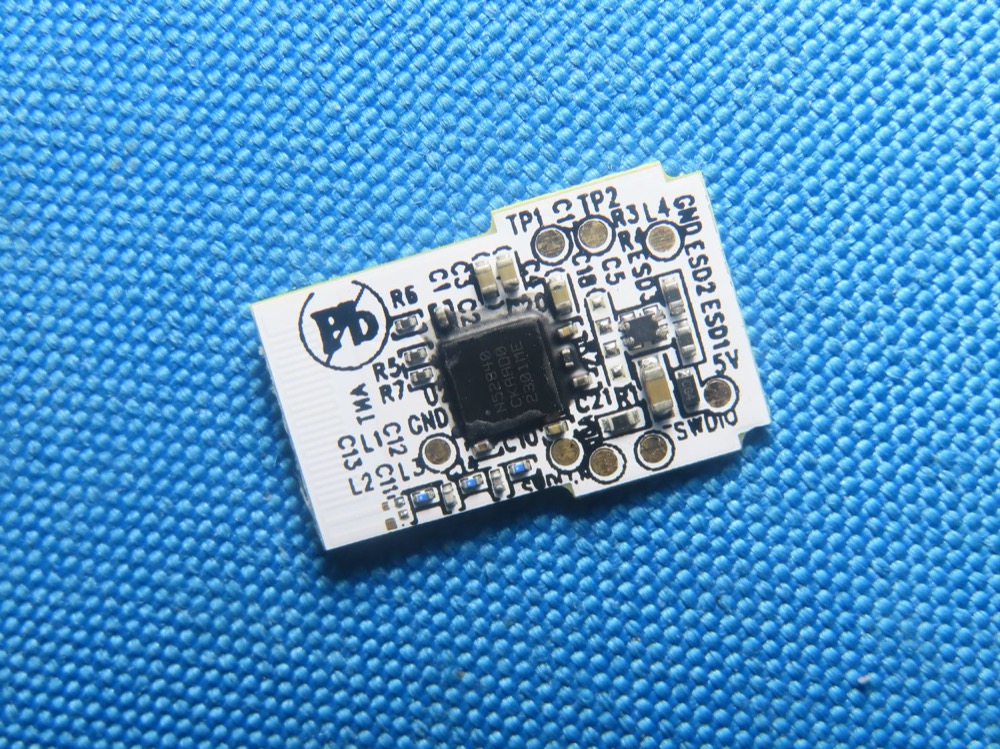
- SWD pads are labeled on the PCB — the custom-firmware entry exists in hardware (see the dongle close-up in Hardware).
 - Stock images are carved and inventoried (see
Version inventory) — there is a return path via SWD.
- Full behavior reference: the entire wire protocol (keymap
records, LED maps, settings, module config) is documented in this
KB — the porter knows exactly what the stock FW does.
- Stock images are carved and inventoried (see
Version inventory) — there is a return path via SWD.
- Full behavior reference: the entire wire protocol (keymap
records, LED maps, settings, module config) is documented in this
KB — the porter knows exactly what the stock FW does.
What blocks it
- Signed + encrypted bootloader (RSA-2048). The stock bootloader rejects anything not signed by Naya's private key, and the company is defunct — no keys, no DFU path. Only SWD erase + full custom build (see Signing).
- Tight SoC: nRF52811 has 192 KB flash / 24 KB RAM. ZMK targets bigger siblings (52840-class); only a stripped-down feature set fits, if at all. This is the single biggest technical risk.
- Unknown USB MCU: the component side of the V13 mainboard appears in no filing — identity and pinout of the USB MCU in the halves are unknown (see Hardware).
Still unknown (drivers to write blind)
- Key-matrix scan wiring and the LED driver chain.
- The split-link radio protocol between halves (plus the left-proxies- right host topology — see Transport).
- Module radios and the pogo-pin protocol (power flows both ways; data protocol undocumented).
- Battery-gauge calibration (host-computed from
de/100bmillivolts).
Verdict
A minimal ZMK build (keys + basic split, no modules, no per-key RGB effects) is conceivable for someone with nRF/Zephyr board-bring-up experience and a SWD probe. A full-featured port (modules, LED engine, power management) requires reverse-engineering several undocumented subsystems first. Start with the disassembly archive and the command map.