Power architecture
Power flows both ways over the module pogo pins (user-confirmed):
- Plugged in (USB): USB → half → docked module (base charges module).
- Off USB: docked module → half (the big module pack powers the half).
The 50 mAh base cells (FH301217) are hot-swap buffers — they keep a half alive while you swap modules, they are not the runtime source.
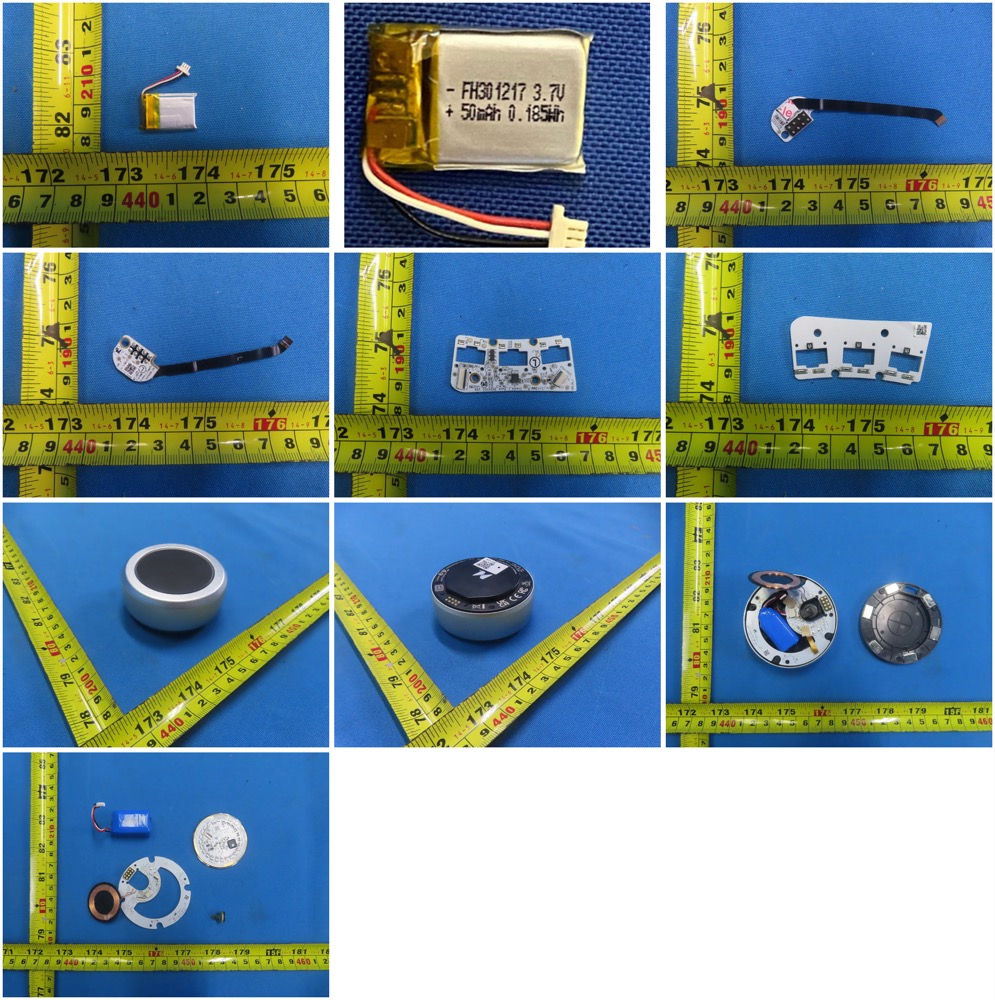
FCC teardown sheet — top-middle cell reads FH301217 3.7V 50mAh
0.185Wh (the buffer); bottom row shows an opened module with the big
blue pack and the copper Qi coil (FCC internal photos).
Consequences (all verified live)
- Discharge tests: unplugged + docked drains the big module packs slowly. To sag the base cells, undock the modules overnight.
- “True cold boot” (the only real MCU reset besides
ee/10ce): USB out + modules undocked + on/off switches. Flipping the switch with USB plugged in is NOT a reset (proven in the boot-trap era). - Module battery % is host-computed, not on the wire:
de/100bpayload[00, HI, LO, 00]= module-rail voltage in millivolts (big-endian). NayaFlow maps it to % with calibration ≈ 4222 mV→100 %, 3910 mV→67 %, 3709 mV→45 % (~9.3 mV/% in that region). Samples: full Touch0x1064=4196 (app showed 4222), discharged Track0x0E82=3714 (app 3709) — within charging drift. - Base voltage candidate:
fe/1006bytes[1..2] big-endian mV (dumps read ~4088 left / ~4087 right; screenshots 4091/4098 later — drift direction consistent with USB charging). - Empty-dock quirk: with no module, right reports
de/100bzeros while left floats at ~0x1060(charger rail unloaded). Usede/1001byte1 as the true presence flag, neverde/100b.
Rails at a glance (healthy board, USB)
| Source | Value |
|---|---|
Module rail (de/100b) |
~4200 mV full, ~3700 mV low |
Base rail (fe/1006) |
~4090 mV, rises on USB charge |
| Module FW / base FW | 0.2.3.3 / 0.3.41.0 |
| Base cells | 50 mAh buffers only |
| Module packs | ~600–1000 mAh (the real batteries) |